While the world lurched to the likes of Nirvana, Pearl Jam and the Smashing Pumpkins, the Californian-born five-piece quietly went about their noisy business. They substituted art for angst across half a dozen albums of loopy guitar pop and occasionally risked a genuine hit to break them out of cultdom.
But that's largely where they stayed until the band fell apart near the end of last century, having made numerous playing visits to these shores.
And here they were again, ten years on and playing a screwy, celebratory first show of a reunion world tour at a sold-out Auckland Town Hall, a venue they would have struggled to fill in their heyday.
But out front was an audience largely made up of nostalgic Gen-Xers who might be wondering why they've become such a target market of late with this show coming in between reunion visits to Auckland by Faith No More and the Pixies.
While guitarist and sometime singer Scott "Spiral Stairs" Kannberg admitted to some first night nerves, the band delivered a 20-plus song set centred largely on their early albums with only a few false-start glitches - and Pavement were always a group where haphazard energy ruled over technical precision.
And one of true personality, largely care of frontman-guitarist Stephen Malkmus and his cryptic lyrics aligned to nifty pop hooks and raygun riffs.
Having continued post-Pavement fronting his own band the Jicks, Malkmus wasn't lacking for stage confidence, throwing all sorts of shapes while showing more guitar muscle than he might have had in the good old days. His voice packed up a little towards the end, though, blaming a cold.
After a slightly ambling start the set soon found its own momentum, saving the almost-hits of Cut your Hair and Stereo for the finale and encore Along the way Kannberg's own earthier songs offered a pleasant reprise from the band's trademark zaniness while percussionist/keyboardist/slide whistle player and backing singer, er, shouter Bob Nastanovich was a sideshow in himself.
It was a show of many magic moments, whether it was the best tennis-inspired indie rock song ever (Stop Breathing) or the tsunami guitar surge beneath Grounded, or the countrified Range Life with its lyrical skewering of some of those aforementioned "important" bands of the Lollapalooza era ("it's not a protest song," pleaded Malkmus). Altogether, that made for one happy reunion of band and fans and oddly enduring songs.
Likewise, in support reformed Dunedinites the 3Ds and their tunes proved they had made it through the 90s rock wormhole intact and energised, with the likes of Outer Space and Hellzapoppin reminding that there's still plenty of gunpowder and stray sparks in their musical fireworks.
The Beatles – Abbey Road (1970) The cover photograph was taken by photographer Iain Macmillan. Macmillan was given only ten minutes around 11:30 that morning to take the photo on a zebra crossing on Abbey Road. That cover photograph has since become one of the most famous and most imitated album covers in recording history. In the photograph, the Beatles walk across the street single file from left to right, with Lennon leading, followed by Starr, McCartney, and Harrison. McCartney is bare-footed and out of step with the other three. The photograph also played a prominent part in the "Paul is dead" urban legend in late 1969. With the exception of Harrison the group are wearing suits designed by Tommy Nutter. The man standing on the pavement in the background is Paul Cole (c. 1911 – 13 February 2008), an American tourist unaware he had been photographed until he saw the album cover months later. The zebra crossing today remains a popular destination for Beatles fans.
Pink Floyd – Animals (1977) Once the album was complete, work began on its cover. Hipgnosis, designer of the band's previous album covers, offered three ideas, one of which was a small child entering his parents' bedroom to find them having sex—“copulating, like animals!”—but unusually the final concept was designed by Waters. At the time he lived near Clapham Common, and regularly drove past Battersea Power Station, which was by then approaching the end of its useful life. The building was chosen as the subject of the cover image, and the band commissioned German company Ballon Fabrik (who had previously constructed Zeppelin airships) and Australian artist Jeffrey Shaw to build a 30 feet (9.1 m) pig-shaped balloon (known as Algie). The balloon was inflated with helium and manoeuvred into position on 2 December, with a trained marksman ready to fire if it escaped. Unfortunately inclement weather delayed shooting, and the band's manager Steve O'Rourke had neglected to book the marksman for a second day. The balloon broke free of its moorings and ascended into the sky. It eventually landed in Kent, and was recovered by a local farmer, reportedly furious that it had "apparently scared his cows" The balloon was recovered and shooting continued for a third day, but the image of the pig was later superimposed onto the cover photograph as the early photographs of the power station were considered to be better. The album's theme continues onto the record's picture labels. Side one's label shows a fish-eye lens view of a dog and the English countryside, and side two features a pig and sheep, in the same setting. Drummer Nick Mason's handwriting is used as a typeface throughout the packaging. The gatefold features monochrome photographs of the dereliction around the power station.
Bob Dylan – The Freewheelin Bob Dylan (1963) The street on the album cover is Jones Street in Greenwich Village, a small street west of 6th Avenue and between Bleecker Street and 4th St. (positively!) The photograph was taken in February 1963 by Don Hunstein. Dylan lived a short ways away at 161 West 4th Street at the time.
Led Zeppelin –Houses of the Holy (1973) The cover art for Houses of the Holy was inspired by the ending of Arthur C. Clarke's novel Childhood's End. (The ending involves several hundred million naked children, only slightly and physically resembling the human race in basic forms.) It is a collage of several photographs which were taken at the Giant's Causeway, Northern Ireland, by Aubrey Powell of Hipgnosis.
Led Zeppelin – Physical Grafitti (1975) The two five-story buildings photographed for the album cover are located at 96 and 98 St. Mark's Place in New York City. To enable the image to fit properly with the square format of the album cover, the fourth floor had to be cropped out, making them appear as four-story buildings in the image. Also where the Stones ‘Waiting on a Friend’ video was shot in 1981.
The Velvet Underground – Live at Max’s Kansas City (1970) 213 Park Ave S New York City Recorded on a tape recorder by Warhol disciple Brigid Polk, LMKC is said to be the last VU performance to include frontman Lou Reed. The concert was part of the … Velvet's nine-week stint at Max's, a one time nightclub/restaurant frequented by the glammy likes of Warhol, Bowie, and Iggy Pop. The club closed in 1981 and now stands as the Green Café, one of Manhattan's umpteen unremarkable delis.
The Doors – Morrison Hotel (1970)
Morrison Hotel, 1246 Hope Street and West Pico Blvd, Los Angeles. The Morrison Hotel in downtown Los Angeles, where the album's cover photo was snapped, closed its doors in 2007. Prior to that, the hotel had been low-income housing for residents of the central city.
Mazzy Star – She Hangs Brightly (1990) Main Stair Hall on the Ground Floor Emile Tassel House in Brussels, Belgium. Victor Horta was the architect for this sophisticated home, built from 1893-97.
Wilco – Yankee Hotel Foxtrot (2002) The cover of the album is a picture of Marina City in the band's adopted hometown of Chicago. Marina Towers Condominium Association 300 North State Street Chicago
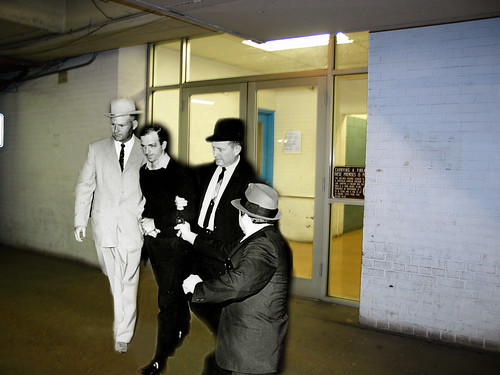
"Past and present collide as Detectives L.C. Graves and James Leavelle escort Lee Harvey Oswald through the basement of Dallas Police Headquarters, as it appears now. Oswald, Jack Ruby, Leavelle and Graves stand precisely where the murder occurred on November 22, 1963. Jim Leavelle is the only key player still alive today.